Location and Institutional Affiliation to Sera/Se ra
Most of the Sera hermitages are located in the mountains to the north, east and west of the monastery along a (roughly) fifteen kilometers east-west span from Jokpo and Gönpasar hermitages in the far west to Nenang in the far east. The rough map that follows gives the relative location and some basic information about the hermitages of Sera as of 2004. The map operates on a usual north-south axis, with the mountains to the north of the hermitages and the city of Lhasa to the south. The hermitages to the right (northeast) of Sera are located in what is today a suburb of Lhasa known as Dodé.8 The hermitages to the left (northwest) of Sera are located in the suburb known as Nyangdren.
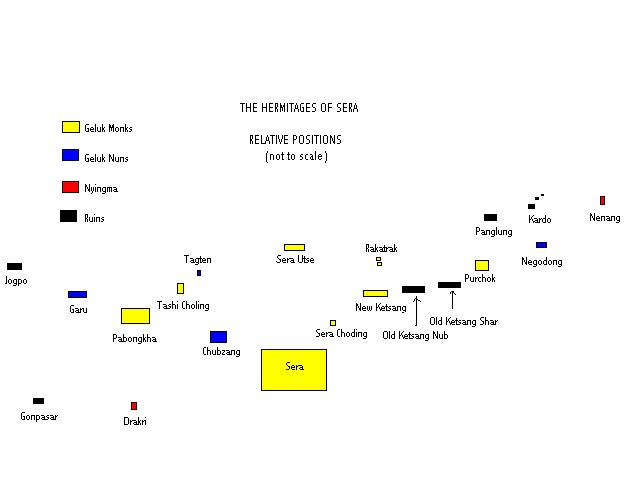
In 1959, all of the hermitages on this map were thriving institutions. Two of them – Negodong to the east, and Garu to the west – were nunneries. The rest were monasteries for male monks. They ranged in size from about ten to well over one-hundred monks or nuns. In the case of monks’ hermitages, it was not uncommon for there to have been a core group of six to eighteen fully-ordained monks (gelong) that is what gave the institution its formal status and legitimacy as a monastery. But all of the monasteries also had many novices, non-monastic lay workers and support staff. If the hermitage was also the seat of a labrang or lama’s estate/household, the support staff (including novices) could be three to four times as large as the number of fully ordained monks. For example, the Keutsang West Hermitage (Keutsang Nup Ritrö), the official residence of the Keutsang Lamas, had a core group of twenty-five fully ordained monks, but if one includes novices and non-monastic staff the population was closer to ninety.9
Of the nineteen Sera hermitages nine were the seats of lamas – that is, they were the headquarters for lama’s estates. With two exceptions (noted below) the name of the lama lineage and that of the hermitage were identical. The lama’s estate hermitages were:
- Jokpo
- Gönpasar
- Drakri
- Trashi Chöling, since 1930 the seat of the Pabongkha Trülkus
- Sera Utsé, the seat of the Drupkhang Trülkus
- Keutsang West
- Purchok
- Panglung
- Khardo
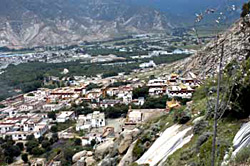
Sera as viewed from Chöding Hermitage (Chöding Ritrö).
Despite the fact that all of the hermitages are called “hermitage of Sera” (Seré ritrö), their relationship to Sera is actually quite varied and often shifts over time. Some are related to Sera only insofar as they were founded by Sera monks, or because as they were taken over by Sera monks at some point in their history. In several cases, hermitages were independent institutions with only nominal ties to Sera. In other instances, hermitages were actually the property of Sera. In between these two poles – minimal affiliation to Sera at one extreme, and ownership by Sera at the other – there were a variety of kinds and degrees of affiliation. If the hermitage belonged to a Sera lama, then it was this lama, and not Sera, who owned the hermitage. But even then there could be different degrees of affiliation between Sera and the hermitage.
For example, in 1959 Keutsang West belonged to the Keutsang Lama. All of the monks of the hermitage belonged to the Keutsang Lama’s estate (Keutsang Labrang). But all of the official monks of Keutsang were also official monks of the Hamdong Regional House (Hamdong Khangtsen) of Sera Jé College (Sera Jé Dratsang), and enjoyed all of the privileges of being Sera monks with regional house affiliations.10 Purchok Hermitage (Purchok Ritrö), by contrast, appears to have been much more independent, and had a weaker affiliation to Sera. Purchok monks belonged principally to the Purchok Lama’s estate (Purchok Labrang), and it appears that many (perhaps most) did not have official membership in either the Jé College or in one of its regional houses.
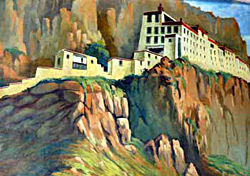
A painting of what Keutsang West Hermitage looked like before 1959.
To take another example, the nunneries11 of Garu and Negodong belonged not to Sera but to the lama’s estates of the Drakri and Khardo lamas, respectively, and these lamas served as their abbots. It is clear, then, even from these few examples, that the question of the institutional relationships of these hermitages to Sera is a complex one. Because few elder monks from these various monasteries are still alive, it is a challenge to piece together the kinds of affiliation that the various hermitages had to Sera before 1959. This is something that in many cases still remains to be determined.
Clearer is the present status of the hermitages today. In 2004, hermitages were either independent institutions or they belonged to – in the strong sense of being staffed and run by – Sera. Of the twelve hermitages that are still active (i.e., that are not in ruins) and that remain Geluk, five belong to Sera: Jokpo, Pabongkha, Sera Utsé, Sera Chöding, and Rakhadrak. The other three male-monk hermitages (Trashi Chöling, Keutsang and Purchok) and the four nunneries (Garu, Takten, Chupzang, and Negodong) are independent institutions. The affiliation of a hermitage today is largely the result of who claimed and rebuilt it after the Lhasa municipal government began to give permits for this purpose in the 1980s. Sera laid claim to the five hermitages it owns today. It has at least partially rebuilt four of these. One (Jokpo, located to the far west in the pasture lands of the Nyangdren Valley) is used as the base for its herds of yaks, and has been only minimally rebuilt. The other hermitages – the ones that do not belong to Sera today – were rebuilt by individuals, albeit with community support. Trashi Chöling was rebuilt by a devotee of Pabongkha Rinpoché, the previous lama-owner. Keutsang and Purchok were rebuilt by former monks of those hermitages, as were Garu and Negodong nunneries. Takten and Chupzang were slowly taken over by nuns with no formal prior affiliations to these institutions. They therefore became nunneries simply by virtue of the fact nuns gradually moved to these sites over the years.
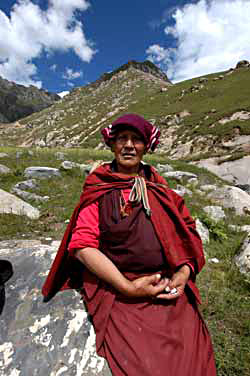
A nun-meditator from Nenang Hermitage.
As one can see from the map, most of the hermitages survive to this day as Geluk institutions (either as monks’ hermitages or as nunneries). Of the nineteen12 original hermitages, all but two remain Geluk. Drakri (mixed nuns and Tantric priests, located in the far south), and Nenang (a nuns’ retreat center in the far northeast) are now Nyingma practice centers (drupdra).
Of the original nineteen hermitages, five are in ruins and have not been rebuilt. It is interesting that most of the hermitages that have not been rebuilt – Jokpo and Gönpasar in the far west, and Panglung and Khardo in the far northeast – lie farthest from Sera. New Keutsang is in fact the newly rebuilt version of Keutsang West, and so one can count Keutsang West as one of the hermitages that has been rebuilt (albeit not in exactly the same site as the original institution). Keutsang East (Keutsang Shar) belongs to Purchok Hermitage and lies in ruins. The monks of Purchok have decided to put their energies into the main Purchok hermitage rather than taking on the additional burden of rebuilding Keutsang East. With this one exception, then, the rule (just mentioned) applies: the closer a hermitage was to Sera, the greater its chances of being rebuilt.