History
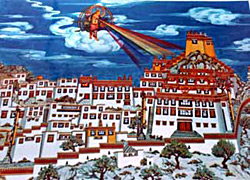
A stylized painting of Purchok Hermitage as it existed before 1959. The deity shining rainbow light from the clouds onto the monastery is Byams Pa
Several of the hermitages have a history that predates the rise of the Geluk school. For example, Pabongkha, arguably the most important of all of the hermitages, is said to date to the imperial period. Nenang is said to have been a retreat site of Guru Rinpoché, and, if this is true, dates to the ninth century. Garu Nunnery (Garu Gönpa), founded by Pa Dampa Sanggyé (b. eleventh century), dates to the eleventh century, and Spangs lung, originally the meditation site of one of Pa Dampa Sanggyé’s students, to the early twelfth century. Of course, each of these sites was later taken over by Gelukpa monks, and so even when a site has a pre-Geluk history, it also has a Gelukpa “founder.”
Tsongkhapa (1357-1419), the founder of the Geluk school, is intimately connected to three hermitages – Sera Chöding, Sera Utsé, and Rakhadrak. Each of these are places where Tsongkhapa meditated, taught, and/or authored some of his most important works.13 So there is a sense in which Tsongkhapa “founded” these three hermitages in the fifteenth century, even if he himself probably had no notion of establishing formal institutions at these sites. And, indeed, there is no other founder of Chöding ever mentioned besides Tsongkhapa. But the tradition considers another later lama, Drupkhang Gelek Gyatso (1641-1713) to be the founder of the other two hermitages – Sera Utsé and Rakhadrak – at least qua monastic institutions. Two other hermitages were founded in the sixteenth century: Negodong Hermitage (Negodong Ritrö), founded by an eminent Sera scholar, Gomdé Namkha Gyeltsen; and Takten Hermitage (Takten Ritrö), founded by one of the most famous early meditators of the Geluk tradition, Ensapa Lozang Döndrup (1504/5-1565/6), who is often reckoned as the Third Penchen Lama (Penchen Kutreng Sumpa). One hermitage, Chupzang – founded by a monk who was a student (and regent) of the Fifth Dalai Lama (Dalai Lama Kutreng Ngapa, 1617-1682) as well as the uncle of his most famous regent, Desi Sanggyé Gyatso (1653-1705) – was established in the seventeenth century. But the remaining hermitages, eleven in all, were founded in the eighteenth century.
Why this spurt of hermitage-building in the eighteenth century? Why this passion for “taking to the hills” at this particular moment in time? Socio-economic and political factors may have played some role in monks’ decisions to leave Sera and seek the relative peace and quiet of the mountains. We know, for example, that by the late seventeenth century, Sera had a monastic population of close to 3,000 monks.14 While an intellectually stimulating atmosphere in which to pursue one’s studies, a monastery of this size is hardly the type of place that a monk with a contemplative bent would want to call home. Moreover, the eighteenth century saw a huge building boom at Sera. All three of Sera’s largest temples – the Sera Great Assembly Hall (Sera Tsokchen), the Jé College Assembly Hall (Jé Dukhang) as well as the Mé College Assembly Hall (Mé Dukhang) – were built between 1707 and 1761. This means that during these years monks would have had to put up with the chaos that comes from living in the midst of large-scale building projects. Nor is it inconceivable that junior monks, even if they were textualists, might have been conscripted to serve as laborers in these mammoth architectural undertakings.

A detail of a painting of Sera from the eighteenth century depicting the monastery before all of the major temples had been constructed. The large (light blue) building in the rear of the monastery is undoubtedly the original Sera Assembly Hall (today the assembly hall of the Tantric College [Ngakpa Dratsang]). The three-story white building in the lower left may be what today is called the Sera Tekchen Khangsar, a palace-like residence said to have been built by Desi Sanggyé Gyatso. This image is a detail of Item No. 65275 in the Collection of the Rubin Museum of Art, from the www.himalayanart.org website.
Political factors also might have played a role in the exodus of monks. With the growth of the Densa Sum – the three great Geluk seats of learning – there also came increased political power for these institutions. After the Fifth Dalai Lama’s consolidation of power in the middle of the seventeenth century, the seats of learning began to play an increasingly important role in Tibetan politics. While perhaps not as influential as Drepung – the seat of the Ganden Palace (Ganden Podrang), the headquarters of the Dalai Lama’s government – Sera, as the closest of the three seats of learning to Lhasa – also played a major role in the politics of the day. Sera monks, we know, took stances either in support of or opposition to the Qushot Mongolian chief, Lhazang Khang (d. 1717), in his successful bid to overthrow the Fifth Dalai Lama’s regent, Desi Sanggyé Gyatso, in 1705. For example, the then-abbot of the Mé College (Dratsang Mé) of Sera opposed Lhazang Khang, a position that he paid for with his life once the Qushot ruler came to power.15 But Lhazang Khang also rewarded the seats of learning financially when they supported him. At Sera, for example, he built the Great Assembly Hall, and he moved his personal ritual college into the old Sera assembly hall – today the site of the Sera Tantric College. In the same year that he had the Mé College abbot killed, he also gave to Sera the Drongmé estates that used to belong to the regent Sanggyé Gyatso.16
But Lhazang made some fatal political mistakes early in his rule. In the first year after assuming power he (or his wife) had the regent Sanggyé Gyatso beheaded. The following year Lhazang Khang sent the Sixth Dalai Lama (Dalai Lama Kutreng Drukpa, 1683-1706) into exile in Beijing (the Dalai Lama died on the way). Lhazang Khang also set up a puppet Dalai Lama, declaring him to be the true sixth Dalai Lama. Economically, opposition to Lhazang among the Kokonor (Tso Ngönpo) faction of the Qushots caused the latter to withhold donations to the great monasteries. This was financially devastating to the seats of learning, and it caused the Penchen Lama to send a mission to Kokonor in 1716 to try and reinstate Kokonor Qushot patronage of the great monasteries.17 All of these various moves cost Lhazang Khang the support of both the people and the seats of learning, and so when Dzungar Mongolian forces moved against him in 1717, promising to enthrone Kelzang Gyatso (1708-1757), a child from Litang, as the Seventh Dalai Lama (Dalai Lama Kutreng Dünpa), the seats of learning gave the Dzungars their support. They provided these rivals of the Qushots with monk soldiers and scouts who knew the terrain,18 and gave them provisions after their arrival on the outskirts of the city. Sera monks also joined the Dzungar troops as soldiers for the final push against Lhazang Khang.19 The Dzungars defeated the Qushots, but Dzungar rule would prove to be disastrous for Tibet. Even if the seats of learning were spared, the Dzungars sacked and looted Lhasa.20 They began to intervene in internal affairs of the seats of learning, purging what they considered to be the riffraff from the great monasteries.21 Far more serious, they destroyed many Nyingma monasteries, especially in southern Tibet, where they murdered scores of monks and sowed the seeds of bitter sectarian rivalries that would plague Tibet for most of its subsequent history.
The Chinese Manchu emperor – who had managed to protect the young Seventh Dalai Lama from being captured by the Dzungars in 1717 – saw Tibetans’ disillusionment with the Dzungars as an opportunity to weaken this powerful Mongol group that they had for some time perceived as a threat. The Manchus, therefore, decided to march on Lhasa with the young Dalai Lama (a crucial symbol of political legitimacy) in tow. Forming an alliance with several Qushot Mongol factions, and with pro-Qushot Tibetans – most notably Polhané (1689-1747), one of Lhazang’s former and most able commanders – they entered Lhasa in 1720, overthrew the Dzungars, and enthroned the young Kelzang Gyatso as the Seventh Dalai Lama. They also took this opportunity to purge the seats of learning of Dzungar influence by expelling all Dzungar lamas from the great monasteries.22
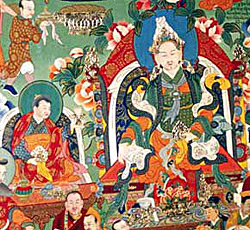 Polhané (right), and his son (left): detail of a mural in one of the regional houses (khangtsen) of Sera (Tibet). | 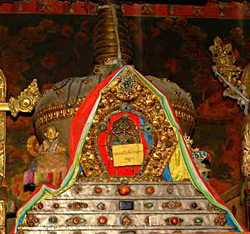 The remains of one of Tibet’s great kings, Polhané, are said to rest inside this funerary stūpa on the main altar in the Jé College Assembly Hall. |
A series of events initiated by the death of the Manchu Kangxi (Kangshi, 1654-1722) emperor in 1722 destabilized the delicate political balance in Lhasa yet again. However, by 1729 Polhané had, with Manchu backing, managed to consolidate power. He ruled for eighteen years and, like his original Qushot mentor Lhazang Khang, he was a great patron of the Geluk seats of learning. At Sera, he is chiefly known as the individual who provided the funds for the building of the Jé College Assembly Hall.23 His funerary stūpa is housed on the main altar of that very building.
As we can see from this brief historical overview, the first half of the eighteenth century was an exceedingly turbulent period in Tibetan history. Sera, it is clear, was a major player in the power-politics of the day. Was Sera’s involvement in the political machinations and power struggles during the first half of the eighteenth century at all related to the establishment of the hermitages? We cannot say for sure, but it is hardly a major leap to conclude that monks with a more contemplative calling – monks who wished to remain aloof from political intrigues in order to pursue study and meditation – might have chosen to avoid an institution like Sera. Or else they might have chosen to enter for a limited time to pursue their studies, but then quickly to exit. And this is in fact what several of the founders of the Sera hermitages did at this precise time.
Socio-demographic factors (such as the size of Sera and its physical expansion), and political factors (such as Sera’s increasing involvement in the chaotic politics of the day) might have been contributing factors to the founding of the hermitages, but one cannot reduce the rise of the hermitage movement to these factors alone. Clearly, religious motivations were at work as well. If the number of hermitages founded during a given period is any indication of a generation’s desire for meditation and isolated retreat, then the eighteenth century must be considered one of the most “contemplative” centuries in the history of the Geluk school, or at least in the history of Sera. It seems likely that the exodus into the mountains at this time was in large part the result of the influence of one charismatic figure, the great meditator and scholar Drupkhang Gelek Gyatso. Drupkhangpa is so important to the history of the Sera hermitage tradition that it behooves us to say a bit more about him.24

A detail of an eighteenth-century painting in the collection of the Rubin Museum of Art (Image no. 105 on the www.himalayanart.org website) identified as Drupkhangpa
Drupkhangpa was born in Zangskar (Zangkar) in 1641. His father died when he was six years old, and he spent most of his youth caring for his sick mother. His mother passed away when he was 17, and it was at this point that he began his religious career. He spent two years at the monastery of Jampa Ling, and then, at the age of nineteen, he set out for central Tibet to further his studies. On his way, he took novice monastic ordination from Drungpa Tsöndrü Gyeltsen (fl. seventeenth century), a student of one of the most important figures in the history of Sera, Khöntön Peljor Lhündrup (1561-1637). Drupkhang Gelek Gyatso then went to Sera. We do not know why his stay there was so short, but he quickly left Sera and enrolled instead at the Dakpo College (Dakpo Dratsang), where he remained for sixteen years. He returned to Drungpa Rinpoché to take full ordination. After Drungpa Tsöndrü Gyeltsen’s death, Drupkhangpa continued his studies at Trashi Lhünpo with some of Drungpa Rinpoché’s students. After a couple of years there, he returned to Sera, where he became a student of the abbot of the Jé College, Jotön Sönam Gyeltsen (seventeenth century). He left Sera sometime shortly after 169225 to begin a series of pilgrimages and meditation retreats in important sites throughout central and southern Tibet.26 He returned to the Sera foothills some thirteen years later, in 1705. It was at this time, it seems, that he founded three hermitages:
- Purchok, where he built the famous Temple of the Three Protectors (Riksum Gönpo Lhakhang). He entrusted this institution to his student, Ngawang Jampa (1682-1762). Tradition has it that Drupkhangpa established Purchok with one-hundred monks.
- Rakhadrak, established with twelve fully-ordained monks, and
- Sera Utsé, established with seventeen fully-ordained monks. He made this latter hermitage his home.
Drupkhangpa influenced several important young scholar-meditators of his day. Purchok Ngawang Jampa we have already mentioned. This influential figure gained a reputation as a brilliant scholar at a very young age. But he also had a passion for meditation, which is obviously what led him to seek out Drupkhangpa as his teacher. It appears that they first met in 1699, but it was not until Ngawang Jampa had finished his studies in 1707 that he began to study intensively with Drupkhangpa. Under Drupkhangpa’s supervision he remained at Purchok Hermitage in meditation for many years. Later in life he was called to public service, most notably as the tutor to the Eighth Dalai Lama Jampel Gyatso (Dalai Lama Kutreng Gyépa Jampel Gyatso, 1758-1804). Purchok Ngawang Jampa is credited in one source with being the founder of another hermitage, Keutsang East. He also influenced other figures in the hermitage tradition: for example, Longdöl Lama Ngawang Lozang (1719-1794), and Yongdzin Yeshé Gyeltsen (1713-1793),27 who founded Tsechokling at the opposite (southern) end of the Lhasa Valley.
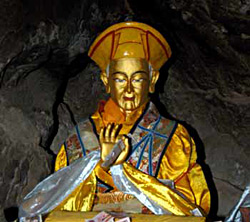 A statue of Purchok Ngawang Jampa, located in the cave in which he first meditated at Purchok, a hermitage that he co-founded with his teacher Drupkhangpa. | 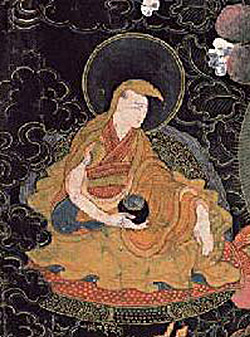 A detail of a painting in the collection of the Rubin Museum of Art (Image no. 105 in the www.himalayanart.org website) identified as Khardo Zöpa Gyatso (1672-1749). |
Another student of Drupkhangpa, Khardo Zöpa Gyatso, also known as Lozang Gomchung, was responsible for founding the Khardo Hermitage on the mountainside across the road from Purchok.28 Khardo Zöpa Gyatso was born near Lhasa in 1672. He entered the Jé College of Sera when he was thirteen years old and studied all of the major scholastic subjects under the Jé Khenpo Gyeltsen Döndrup (seventeenth century). At age twenty, Khardowa took full ordination under this same teacher and then spent the next several years in retreat in different locations in central and southern Tibet. It was during this time that he perfected different alchemical techniques for extracting nutritive powers from water, pebbles, and flowers.29 In 1706 he came back to Lhasa with the few students that he had gathered in his travels. It was perhaps at this time that he apprenticed himself to Drupkhangpa.30 In any case, we know that it was shortly after his return to Lhasa that Khardowa settled on a bluff at the far northwestern end of the Lhasa Valley, across from Purchok, where he began to build a hermitage, and to teach extensively. He continued to travel intermittently even after he had founded his small hermitage, gathering many students from different parts of Tibet.
Khardo Hermitage came to be the dominant force in Dodé (the area northeast of Lhasa). At some point in time, the Khardo Hermitage assumed responsibility for the small hermitage of Negodong that was located just beneath it at the foot of the mountain near the village of Dodé. And in the mid-nineteenth century, the third Khardo Lama, Chökyi Dorjé (b. eighteenth century?), built Nenang Nunnery at the far end of the Dodé Valley. These three hermitages – Negodong, Nenang, and Khardo itself – came to be known together as “the three practice centers of Khardo” (Khardo Drupdé Sum).
To summarize, seven of the nine hermitages to the east of Sera were founded either by Drupkhang Gelek Gyatso or by one of his direct disciples in the eighteenth century. Panglung Hermitage, just behind Purchok, was founded by one of Drupkhangpa’s great-grand-students, Panglung Kutreng Dangpo Lozang Tukjé (1770-ca. 1835).31 The chart that follows traces the teacher-student relationships between some of the figures we have mentioned so far.
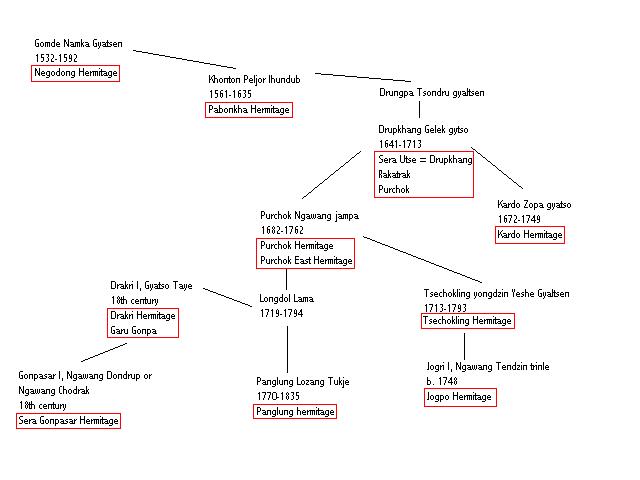 |
The building of hermitages in the environs of Sera comes to a halt around the end of the eighteenth century. After the beginning of the nineteenth century no new hermitages were built. Why? Although we cannot answer with absolute certainty, we can speculate as to the reasons. One possibility is that a kind of saturation point had been reached. Hermitage building always required the permission of the Ganden Palace (the Tibetan government), and it usually required the endowment of these institutions with estates. It is not inconceivable that the government felt that a limit had been reached as regards its ability to provide for these institutions through estate endowments. Or perhaps the government felt that it was putting undue burden on the local populace, which was obligated (morally, if not legally) to further subsidize the hermitages with donations. It is also not inconceivable that the Sera administration might itself have protested the building of new hermitages, since the seats of learning were institutions that competed with the hermitages both for donors and for monks. A second possibility is that, given the relative political stability of the seats of learning from the mid eighteenth century, fewer monks felt the need to leave Sera, making the building of new hermitages unnecessary. Third, perhaps monastic life in the seats of learning became so normalized and idealized that the isolated contemplative life of the solitary yogi was no longer as valued (or as encouraged) as it had been in earlier days. Finally, is not inconceivable that senior monks of Sera dissuaded their more promising students from going into isolated life-long retreat, encouraging them instead to either enter the Tantric Colleges, thereby launching them on the process of ascending through the stages of the Geluk hierarchy, or else to remain as teachers at Sera, where there was always a demand for good textualists. Or perhaps it was a combination of all of these factors that brought an end to the founding of new hermitages.
Not only did hermitage-building cease, but the hermitages that already existed underwent a fairly radical transformation at the end of the eighteenth century. Within one or two generations of their founding, all of the hermitages became prototypical ritual monasteries – that is, monasteries where ritual (choga chaklen, zhapten), rather than, say, individual meditation on the graded stages of the path (lamrim) and on the tantras, was the principal activity of the monks and nuns. True, some hermitages kept a few meditation huts for monks who wanted to do individual retreat, but even those institutions that made room for contemplatives in their ranks transformed into monasteries where the primary focus was ritual. Why did this happen?
The original hermitages began as meditation retreat centers. But to thrive as a meditation retreat center an institution requires the leadership of a charismatic contemplative. Almost all of the founders of the hermitages had this type of drive and charisma. Once these founding figures had passed away, however, the leadership of the hermitages passed on not to a senior student (who might also have had this same vision), but rather to the next incarnation of the founding lama. These later incarnations were rarely as committed to the contemplative life as were their predecessors. There were several reasons for this. The young incarnations (trülku) – or lamas, as they are called in the seats of learning – were given official status at Sera.32 As lamas they were expected to enter Sera for their studies, where they were then enculturated from a very early age into the life of the seat of learning and into its ethos. Wherever the yearning for a contemplative life comes from, it does not generally come as the intentional product of seat of learning life. Put another way, the goal of the seats of learning was not to produce hermits and meditators, but to create scholars who were the embodiments of the Geluk tradition: to fashion monks who exemplified the teachings of Tsongkhapa through their learning, comportment, and ritual skills. Young lamas learned this lesson well, and they almost never rejected this ideal in favor of the life of the solitary yogi. This is not to say that the life of the solitary meditator-yogi was not (and is not) an ideal among the Gelukpas (Tsongkhapa, after all, was precisely this for much of his life), nor is it to deny that many lamas also might have had such an inclination. But even those lamas who had a yearning for the hermit’s life would have found it difficult to live out this calling by renouncing their position and heading to the mountains, for once a young boy had been identified as the leader of a now-institutionalized hermitage, there were a variety of forces and interests to keep him in this position. For example, the lama’s household (or lama’s estate) depended on the physical presence of the lama for its fiscal survival, and the hermitage, in turn, depended on the lama’s estate for its financial stability. In brief, there were many reasons – sociological, economic, and even political – that caused the subsequent incarnations of the hermitages’ founders not to be as committed to the kind of contemplative lives that their predecessors had led. Lacking the contemplative charismatic leadership of the original founders, it is not surprising that the institutions headed by these individuals also changed. But change into what? There was no need for the hermitages to transform into educational institutions. The seats of learning already had a monopoly in this sphere, and the smaller monasteries near an institution like Sera could not have competed with the seats of learning when it came to providing monks with a textual education. This left only one other option: ritual. In the absence of leaders with contemplative charisma, the only option for the hermitages was to transform into institutions whose primary focus was communal ritual. And this is in fact what happened.
Perhaps the historical lesson here is a simple one: hermitages (or, to be more specific, Geluk hermitages near the seats of learning) do not stay isolated, meditation-oriented institutions for long. The centripetal pressure to grow, and the centrifugal pressure to institutionalize, to become part of the Geluk establishment and to become affiliated to larger and more powerful institutions like the seats of learning is simply too great for these establishments to remain small, independent, and contemplatively-driven for very long. With their transformation into ritual institutions, the hermitages were, of course, no longer the classical “solitary sites” (ené) sought out by yogis. And just as the founders of the hermitages had to leave Sera for the mountains around the monastery in order to pursue their contemplative vocation in the eighteenth century, latter-day yogis would have to leave not only Sera but also the hermitages. At least this is what they would have to do if their goal was to meditate in relative isolation and without the responsibilities that come from being a member of a ritual monastery.
After the events of 1959, the hermitages were all forcibly shut down and fell into disrepair. Monks and nuns started rebuilding them after the liberalization of the 1980s. Most of the hermitages were rebuilt in the 1990s. Initially, the local Lhasa government was fairly generous in granting permits to rebuild these institutions. In the last few years, however, it has been close to impossible to get permission to rebuild – and, indeed, even to add new structures to already rebuilt hermitages or to make modifications to existing buildings. The attitude in the Lhasa bureaucracy today is more stringent in part because of the prevailing attitude among government bureaucrats that there are already too many monks and nuns in and around Lhasa. (This is not surprising, given that monastics have been very vocal in protesting the Chinese occupation of Tibet over the last two decades.) Hence, there are restrictions not only on rebuilding and renovation, but also on the number of monks and nuns that can live in the hermitages. As a result, those five hermitages that have not already been rebuilt will probably never be rebuilt. As the elder monks who knew the traditions of these institutions pass away, these institutions, like so much of Tibet’s rich religious culture, will disappear from cultural memory just as they are physically disappearing from the landscape of Lhasa.
But let us end on a less gloomy note. It is a great irony that, in the wake of the destruction of the hermitages, some of these sites are once again becoming retreat centers for meditators. This is not to say that the newly renovated hermitages have renounced their focus on ritual. They have not. Rather, it is the ruins and caves of the hermitages that have not been renovated that are serving as homes for contemporary yogis (mainly nuns). For example, nuns have settled at Nenang and Khardo, transforming these ruins into meditation retreat centers – which is to say, into the types of places that their founders originally intended them to be. The phoenix rising out of the ashes of its own burnt body comes to mind as an appropriate metaphor for this phenomenon.