The Gomang Monastic College (Gomang Dratsangsgo mang grwa tshang)
Gomang is one of the three philosophical monastic colleges (tsennyi dratsang) that have survived at Drepung to the present day. Until 1959, it was second in size, after Loselling. Hard numbers are hard to come by but it is not unreasonable to assume that Gomang had two or three thousand monks in 1959, with a few hundred of them being actively involved in scholastic studies. Most of its monks came from Amdo and Mongolia, but some came from Central Tibet, Tsang, and Kham. Its main protectors were the Lion-Faced Goddess (Sengdongma), which was in charge of the college proper, and Gadong, who was in charge of protecting the scholastic manuals (yikcha). Special attention was also paid to the tenma, particularly Dorjé Drak Gyelma and Dorjé Yüdrönma.

Lion-Faced Goddess in the Loselling Assembly Hall.
Gomang was founded by Drung Drakpa Rinchen, about whom we know very little. He was a direct disciple of the founder of Drepung, Jamyang Chöjé (1379-1449 CE), but was not counted among the latter’s fourteen major disciples. Drakpa Rinchen’s two successors, Galep and Taklep, were more significant. They were the second and third abbots of Gomang and had an important role in making this monastic college one of the main scholastic centers at Drepung. The circumstances of the foundation of Gomang are not known. It is the oldest monastic college at Drepung and there are unconfirmed reports that it occupied at first what is now the Main Assembly Hall (Dukang) before moving to its present site. This move, however, did not occur completely smoothly. According to a legend, a monument residing in the Main Assembly Hall protested the move, saying, “I do not want to move.” The statue’s wish was respected. It was left in the Main Assembly Hall where it was known under the name of monument.
Despite its relatively modest size, Gomang has produced a number of important Geluk thinkers. Gungru Chökyi Jungné wrote some of its earliest scholastic manuals, which were later replaced by the more extensive writings of Jamyang Zhepa (1648-1721/1722 CE), who became the leading thinker of the monastery. This extremely prolific writer left his native Amdo in 1688 to start his scholastic career at Gomang. There he studied the topics contained in the scholastic manuals and the great commentaries of the Geluk tradition. He quickly came to show great promise as a scholar and after a few years he was advised to go on a scholastic tour at Sangpu. There he defended successfully Tsongkhapa’s views against the criticisms of Sakya thinkers such as Taktsang. At the age of twenty-eight he became a spiritual teacher (geshé) and moved to the Tantric Monastery of Lower Lhasa (Gyümé), where he spent five years studying the great tantric systems of the Geluk tradition. In 1681, he left the monastery to retire in a cave on Dge ’phel Mountain above Drepung. There he spent the next twenty years, dividing his time between contemplation and writing. It is there that he composed his great treatises whose study forms the core of the Gomang curriculum.

Jamyang Zhepa
Despite his retirement, Jamyang Zhepa played an important role in the troubled politics of his day. The Fifth Dalai Lama (Talé Lama Kutreng Ngapa) had died in 1682 but his prime minister, Desi Sanggyé Gyatso (1653-1705 CE), refused to make his death public for another fifteen years. This unusual situation made the discovery of the reincarnation of the Dalai Lama (Talé Lama) difficult, and even the recognition of the Sixth Dalai Lama (Talé Lama Kutreng Drukpa) did not solve all the problems. The new Dalai Lama (Talé Lama) did not behave as he was expected, refusing to follow the monastic path of his predecessors. The issue became entangled in the power struggle among the contenders for supremacy in Tibet, the Desi and his allies, the Geluk monastic seats, the various Mongol figures and tribes associated with Tibetan politics, and the emperor of China. It is in this difficult climate, in 1700, that the Desi appointed Jamyang Zhepa abbot of Gomang, a position he held for seven years. During this time, Jamyang Zhepa taught at Gomang, promoting his texts as the official manuals of the monastic college. He also, however, became more closely involved in politics, participating in the coalition that defeated the Desi’s attempts to take power. Although Jamyang Zhepa may not be responsible for the Desi’s execution, his role illustrates the complexity of the political role of the Geluk establishment of the time. Jamyang Zhepa had been appointed by the Desi, a ruler with whom he had a close relation for many years. And yet, in the confrontation between the Desi and his enemies, Jamyang Zhepa did not support his patron. The Desi’s death was followed by other tragic events. Drepung was attacked and the young Sixth Dalai Lama (Talé Lama Kutreng Drukpa) was taken prisoner, leading to his premature death. It is the midst of these tragic events that Jamyang Zhepa decided to leave the troubled world of Lhasa to retire to his native Amdo. There he created in 1709 the Labrang Tashikhyil monastery, an important branch of Gomang that became a major scholastic center in its own right.
Besides Jamyang Zhepa, Gomang has produced a number of distinguished Geluk thinkers such as Changkya, Sumpa Yeshé Penjor (1704-1788 CE), Tuken Chökyi Nyima (1737-1802 CE) and Gungtang Jampelyang. Gomang monks often state, not without some justification, that their monastic college may be the smallest among the major monastic colleges of the three Geluk monastic seats but that it has had the largest literary production in the last two or three centuries. Other colleges have produced good scholars but their literary production has remained limited, particularly after the adoption by these colleges of a fixed set of scholastic manuals in the sixteenth century. Gomang, on the other hand, has continued to produce interesting writings, even after its adoption of Jamyang Zhepa’s works. The reason for this prolific production is not entirely clear, since the college’s curriculum does not differ substantially from that of other colleges. It may be that this success may be due to its connection with its branch monastery at Labrang, where the curriculum has been less exclusively focused on scholastic studies and more open to the study of less obviously Buddhist topics such as grammar, literature and poetry.
The official name of this monastic college is the Auspicious Many Doors Monastic College (Trashi Gomang Dratsang). It seems to have been called auspicious because it was the first monastic college established at Drepung. The reason for its being called many doors is less obvious. One story is that this college had many highly realized beings in its ranks who were at times too absorbed into meditation to arrive on time at the religious services held in its assembly hall. As they came late, they would join the assembly through walls and closed doors thus giving the impression that there were many doors. Another and less extraordinary explanation is that this name refers to the classical Buddhist teaching of the three doors of liberation (namtar gosum). The monastery would then be the place where the doors to liberation were open by the practice of studies, reflection and meditation.
As its name (Trashi Gomang Dratsang) indicates, Gomang is not just a sub-unit of a larger monastery. Rather, it is a largely autonomous unit, with its own set of rituals, curriculum, and scholastic manuals. Moreover, Gomang had, prior to 1959, its own abbot, disciplinarian and complex administration. Hence, in many ways, Gomang was closer to a monastery than its English description as a monastic college would suggest. Although Drepung was founded by Jamyang Chöjé as a single monastery, it grew quickly and was divided during the fifteenth century into seven monastic sub-units led by abbots appointed by the founder himself. These seven sub-units at first functioned like colleges specialized by topics. Gomang specialized in the study of the prajñāpāramitā literature and madhyamaka, growing into one of the major scholastic colleges at Drepung. In the process, it absorbed the Vinaya Monastic College (Dratsang Dülwa), which was allowed to keep a separate abbotship while its monks became part of Gomang. Hence, prior to 1959, Gomang had a Vinaya [College] estate, which was the seat of the abbot (khenpo) of this nominal college, despite the fact that there were no Vinaya Monastic College monks.

Gomang South Entrance
Prior to 1959, Gomang had sixteen regional houses (khangtsen) where monks from different parts of the Tibetan Buddhist world (including Mongolia) would stay according to their regional origin. There, new recruits (dragyün) would find people able to understand and help them thus providing a means to integrate socially, culturally and linguistically large numbers of monks coming from vastly different groups and backgrounds. There were also monks from other countries, particularly Mongolians, who did not speak Tibetan at all (though they could debate in Tibetan). In a monastic seat of over ten thousand, a regional house, which usually grouped a few hundred monks, provided the kind of group in which newcomers could make connections. Houses also played an important role in the education of monks. They held weekly or monthly formal debates, which provided an arena where more young monks could watch and debate with seasoned scholars.
There were also twenty-two affiliated houses (mitsen) connected with a particular regional house or with Gomang itself. The exact affiliation of some of these houses was not always easy to determine, since they seem to have shifted over time. This affiliation was determined on the basis of complex customary arrangements based on the regional origin of the monks arriving to the monastery and the particular agreements that had been entered into by the relevant parties. Some houses were affiliated with a particular regional house, often Samlo or Hardong, the two largest regional houses at Gomang. But some affiliated houses had a particular status. Two affiliated houses, Gadong and Bözhung, were not affiliated with any regional house but only to Gomang College itself, though its monks were part of the regional house determined by their origin. Other houses were affiliated with more than one regional house. For example, the Tsenpo house was affiliated with both Samlo and Hardong regional houses. Among its monks, those coming from nomadic areas were part of Hardong, a regional house regrouping people coming from nomadic areas, whereas those coming from agricultural areas would be part of Samlo Regional House (Samlo Khangtsen).
Monks were not free to choose which monastery and which regional house they would enter but were directed to a particular monastic college according to their exact place of origin. Each household was connected to a particular local monastery, which in turn was connected to one of the colleges of one of the three monastic seats (in the case of a non-Geluk monastery, monks would be assigned a monastic college according to their precise regional origin, though they may have had greater flexibility than their Geluk colleagues). The authorities of each college jealously kept a detailed register of all the monasteries with which they had a connection, and monks who desired to spend time at the three seats would be automatically directed to the college with which their particular local monastery was connected. In some cases, their local monastery would be connected to more than one college but even then the monks did not have any choice. Rather, the monastic authorities would decide for them by drawing lots to designate which monk would go to which monastic college. In the rare cases where monastic authorities were unable to agree on the affiliation of a candidate, a long dispute would ensue and a case might have to be brought in court against a rival college.
Upon entering a particular monastic college, each monk would be automatically assigned to a sub-unit, a regional house or an affiliated house, on the basis of his local origin. When arriving at the regional or at the affiliated house, the new recruit (dragyün) would often know some relative or indirect acquaintance, who would introduce him to the teacher of the house. This teacher would direct the newcomer to a room teacher (shakgi gegen). This would be one of the most important relationships that the monk would have in his entire life at the monastery. The room teacher lived with the young monk and was in charge of directing his daily life. He introduced him to monastic customs, making sure that he memorized the required texts, behaved properly and went to the required rituals. In the large Tibetan monasteries where each monk was financially self-sufficient and provided for himself, the room teacher was also in charge of the financial accounts. The young monk would give him all the money he had upon entering the monastery and what he got while being in the monastery. The teacher used this money to provide food, clothing and so on. He also provided the young monk with living quarters, often a room that has to be shared with other monks. Every year, teacher and student would establish a balance sheet, so that when the young monk left the monastery or became independent, the room teacher would be able to provide a full account. Any money left was returned to the monk who owned it. Finally, the room teacher was also the person responsible for the young monk. This meant that he was be held responsible by the monastic authorities for the behavior of his student. He would be punished if the young monk got in trouble.
Prior to 1959, Gomang had its own administrative, disciplinary, and religious structure. Its council, which was composed of the abbot, the representatives of the large regional houses, and important monastic officials, controlled the administration of the monastery. The abbot, who headed the monastery, was in charge of its religious activities, overseeing the admission of new monks, the curriculum as well as the ritual calendar. This position gave him great power. Together with the abbots of the other colleges, the abbot was in charge of the whole seat. Although he was limited in his power by the monastic constitution (chayik) and the extremely numerous and complex customary arrangements, he had many opportunities to impose his view and run the monastery according to his plans. He was also an automatic member of the National Assembly and with the agreement of the other abbots could block any measure that he considered to be against the interest of monasteries. He would be seconded in his work by the the college’s disciplinarian (dratsanggi gekö), who oversaw all disciplinary matters within the monastic college, checking that the monks assemble in the proper ways and at the proper time, ensuring that they maintain proper decorum and keep the disciplinary rules of the monastic college. Although he had considerable power, he had to defer to the seat’s two disciplinarians, who were the chief enforcers at Drepung.
The financial administration of Gomang was in the hands of a council of five stewards (chakbuk). Four were designated by the four large regional houses (Hardong, Samlo, Gungru and Drati) and were called chakbuk, whereas the last one represented the abbot and was called labrang chakdzö. These five administrators met on a daily basis and decided on all financial concerns of the monastery. Two secretaries and a representative of the smaller regional houses designated from either Zhungpa, Tewo or Chupzang houses helped the five administrators. If the decision was too important or the five administrators could not reach agreement, they would convey an exceptional council of fourteen members composed of the five administrators, the disciplinarian (gekö), the chant leader (umdzé) and representatives of the important regional houses. If this council could not decide, a plenary session of the monastery, involving representatives from all the regional houses, would meet.
Besides deciding financial matters, the council of the monastic college oversaw the other tasks that were part of the life of the monastery. For example, two store-managers (nyertsang depa) were in charge of providing the teas and food to be offered during the rituals of the college, whereas two caretakers (könnyer) were looking after its headquarters. There were monks in charge of preparing tea and food for the monks participating in the college’s rituals. There were also monks in charge of taking care of the various buildings of the monastic college such as the Assembly Hall (Dukang), the debating courtyard (chöra), the buildings of the administration, whereas others would prepare the offerings, make sure that all of its objects remain accounted for, and so forth. There were also monks in charge of performing the college’s rituals, particularly those of its protectors, marking the time for rituals.
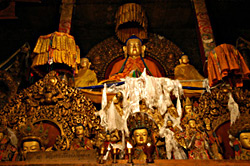
Akṣobhya
If the structure of the monastic college and the role of regional and affiliated houses were well determined in the old days, it is much less so nowadays. In contemporary Tibet, monastic colleges are less important than they used to be. Although monks continue to belong nominally to one of the four colleges, most of the activities, including rituals and scholastic studies, are held together. Moreover, monastic colleges do not have separate administrative structures. Rather, the Democratic Management Committee (DMC, Mangtso Daknyer Uyön Lhenkhang) administers the whole of the monastery. Hence, it often makes little sense in this context to talk about colleges. The same applies to regional and affiliated houses, which do not play much of a role these days at Drepung. There are simply too few monks to staff separate houses and there is very little ritual or scholastic activity that is specific to particular regional houses. Moreover, the regional composition of the monastery has changed drastically. Whereas in the old days, most monks at Drepung would come from Eastern Tibet (mostly Amdo in the case of Gomang) and most regional houses would reflect their origin, nowadays only monks from Central and Western Tibet are allowed to stay at the monastery. Hence, there is little use for regional houses as structures of socialization and the affiliation to regional houses is largely irrelevant. The only function of regional houses is to provide residencies for the monks coming to Drepung.
In exile in India, Gomang has maintained its structure and administrative organization. The sixteen regional houses still exist and have kept some of their original functions, but in a population of refugees that has been in exile for several decades and has acquired a relatively standardized Tibetan language and culture, regional affiliation do not have the same meaning as they had in the old society where culture and language were to a large extent regional. The administrative structure of the college has been maintained. The abbot of the monastic college is chosen by the Dalai Lama (Talé Lama) and the other officials, the disciplinarian, the chant leader, and the four steward monks (chakdzö) in charge of running the monastery, are designated by a vote of the monks. The running of the monastery, however, has been greatly simplified by the fact that the monastery is smaller than it used to be and has much fewer resources. The monastery does not have any estate to administer and the administration of its financial resources is limited to managing the revenue coming from the cultivation of the land, gifts from international sponsors and local Tibetan support. Although this is not always an easy task, it is a far cry from the complex work of administrators in the ancient system. Gone are the prestige and power that were associated with such positions. The governance of the monastery is now more democratic, with fewer decisions in the hands of the abbot and the administrators and more power given to the monks through a process of elections.
The Sixteen Regional Houses at Gomang
- Hardong
- Samlo
- Gungru
- Drati
Four great regional houses
- Lumbum
- Tawön
- Zhungpa
- Ngari
- Zungchu
- Dranyé
- Chepa
- Jadrel
Eight middling regional houses
- Gakshing
- Retsa
- Chupzang
- Tewo
Four small regional houses
The Twenty-Two Affiliated Houses at Gomang
- Tsokha
- Washül
- Jurché
- Hor
- Torgö
- Tsenpo
- Gönlung
- Lamo
- Beri
Nine affiliated with Hardong
- Khelkha
- Gönlung
- Tangring
- Tsenpo
- Bido
- Sku’bum
- Drotsang
- Bajo
- Lenhati
- Lampa
Ten affiliated with Samlo
- Nyenpo
One affiliated with Zungchu
- Gadong
- Bözhung
Two affiliated with Gomang