Location and Layout
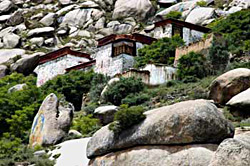
A view of Drakri Hermitage (Drakri Ritrö) from below.
The word drakri means “crag” or “gorge.” As is the case with many hermitages (ritrö), it is difficult to know whether the site got its name from the lama who founded it, or whether the founding lama got his name from the site that he used for retreat. The lama incarnation lineage that owned this hermitage is also (perhaps even more commonly) known as Bari rather than Drakri, and even the hermitage often goes by the name of Bari Hermitage (Bari Ritrö).1
The monastery lies about three kilometers north and slightly east of downtown Lhasa on the side of a mountain above the southernmost section of the suburb of Nyangdren. Drakri is therefore the closest to downtown Lhasa of all of Sera’s hermitages.
As one begins to walk up the hill on the path to the hermitage from the residential portion of Nyangdren, one first encounters several large boulders with images of Guru Rinpoché (eighth century) and other Nyingma deities painted on their surface. Because the monastery became a Nyingma hermitage only since its renovation in the 1990s, these rock-paintings are almost certainly of recent provenance.
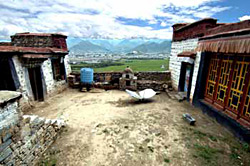
The courtyard of the main temple compound. The temple is on the right, and the kitchen on the left.
The hermitage itself consists of five major sections:
- The main temple compound contained several buildings, all around a central courtyard: the temple, a kitchen, a wing of monks’ living quarters. It also contains a large mani wheel (mani khorlo). This entire compound has been renovated, although the present buildings have fewer stories than did the original ones.
- A large complex built in terraced fashion located just below (south of) the main temple compound. Before 1959 this tiered complex contained stables (at its lowest portion), and work/meeting rooms and the living quarters of the workers and business managers of the Drakri Lama’s estate (Drakri Labrang) on the upper tiers. This entire complex is in ruins today.
- A building that before 1959 served as the living quarters for the eight fully ordained monks who formed the ritual core of the monastic community. It lies southwest of the temple complex. Today, only the foundations of this building remain.
- A stable for dzo, a yak-cow hybrid.
- Several huts. Although at least two such huts exist today (inhabited by nuns), it is not clear whether these structures existed at all prior to 1959.
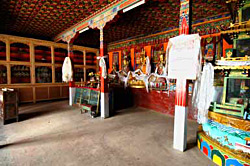
The interior of the main temple.
In 2004, the renovations in the interior of the main temple were not quite finished. All of the images in the temple are new. There are statues of the Buddha, of Guru Rinpoché in various forms, and of several tantric deities. There is also a three-dimensional model of Guru Rinpoché’s celestial palace, the Glorious Copper-Colored Mountain (Zangdok Pelri). One entire wall is filled with pressed-clay tablets (tsatsa) on shelves.
The four tantric priests (ngakpa) that reside at Drakri live in the residential portion of the main temple compound. The two nuns live in huts to the southeast and southwest of the main compound.