History
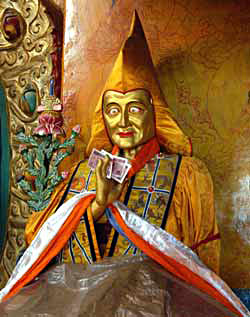
A statue of one of the early Keutsang Lamas in the Maitreya Chapel.
Centuries before Gelukpas began to use the site as a place for meditation retreat, Keutsang was renowned as a retreat site used by famous lamas of the past. For example, it is said that a cave at Keutsang West was a retreat site of the famous twelfth-century founder of the Tselpa Kargyü school, Lama Zhang (1123-1193).3 As has been mentioned, Tsongkhapa also lived at one of the caves here for a period of time. Keutsang West Hermitage (Keutsang Nup Ritrö) was formally established as a Geluk institution by the first Keutsang incarnation Jampa Mönlam (Keutsang Kutreng Dangpo Jampa Mönlam), the seventeenth abbot of the Jé College (Dratsang Jé) of Sera. He retired from the abbacy early to enter into retreat. Taking up residence in one of the caves at Keutsang, he eventually built a retreat hut. Students began to come to him for instruction, and by the time of his death a small institution had coalesced around him at the site.
His reincarnation, the second Keutsang incarnation Lozang Jamyang Mönlam (Keutsang Kutreng Nyipa Lozang Jamyang Mönlam), was born into the wealthy Doring aristocratic family of Lhasa.4 Given the wealth of this family, one might hazard to guess that it was during the time of the second Keutsang incarnation (Keutsang Kutreng Nyipa) that some of the more important buildings at the site were constructed, but only further research will bear this out. We know little about the third Keutsang incarnation (Keutsang Trülku), but the fourth was one of the Thirteenth Dalai Lama Tupten Gyatso’s (Dalai Lama Kutreng Chuksumpa Tupten Gyatso) closest associates. After the Dalai Lama’s death, the fourth Keutsang incarnation (Keutsang Trülku) was one of the principal figures responsible for identifying the present (fourteenth) Dalai Lama. One assumes that because of this the hermitage grew greatly in fame, prestige, and wealth during the time of the fourth Keutsang incarnation. The present and the fifth Keutsang incarnation (Keutsang Kutreng Ngapa) was jailed and suffered greatly during the Cultural Revolution. He left Tibet and went into exile in India in the 1980s.
The hermitage had a strong relationship to Sera throughout its entire history. Every official monk of the hermitage was also, de facto, a monk of the Hamdong Regional House (Hamdong Khangtsen) of the Jé College. This is no longer the case, however, since today the hermitage is an independent institution (albeit one that has amicable ties to Sera Jé College [Sera Dratsang Jé]). While on the subject of institutional affiliations, it should also be mentioned that from the early nineteenth century up to 1959 Keutsang was the official owner of the famous Drapchi Temple (Drapchi Lhakhang) located in the northern part of Lhasa. The Keutsang Lama kept rooms atop the Drapchi Temple for his personal use.
The original Keutsang West Hermitage was destroyed after the events of 1959. Using principally his own funds (and with a great deal of volunteer labor from the local community), a former monk of the hermitage began the work of reconstruction in 1991. By 1992, both the main temple and the secondary temple had been completed and one year later the monks’ quarters were finished. Today the hermitage is home to about twenty-five monks.
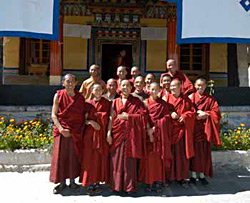
Some of the monks gather outside the main temple for a group picture.
As is the case with all of the Sera hermitages that have survived, Keutsang today is a ritual monastery. The hermitage always celebrates the new and full moon, as well as the tenth and twenty-fifth of the lunar month. Groups of monks will also go to the homes of local villagers to do rituals when requested. This is an essential source of income for the hermitage.
In addition to the regular monthly ritual cycles, the hermitage also, of course, engage in regular annual ritual cycles: for example, during the Tibetan New Year, and in the fourth Tibetan month, when the monks do eight sets of two-day Avalokiteśvara fasting rituals (nyungné). The monks also observe the rainy season precepts in the summer. In the eighth Tibetan month all of the junior monks must submit to a memorization exam on the ritual texts they have learned throughout the year. At this time, a senior scholar from Sera is invited to the hermitage to conduct the examinations.